
Early Warning Signs in an ODM Fragrance Project for a Pharmacy Channel
An ODM fragrance project rarely collapses at the filling line. It collapses in the first four weeks, when the brief is vague, the sample round has no end date and nobody has written down who approves what. A pharmacy channel raises the stakes, because an own-label scent sits on a shelf beside regulated health products and the customers standing there actually read labels. The warning signs are visible early, and the work is treating them as decisions rather than as atmosphere.
Key takeaways
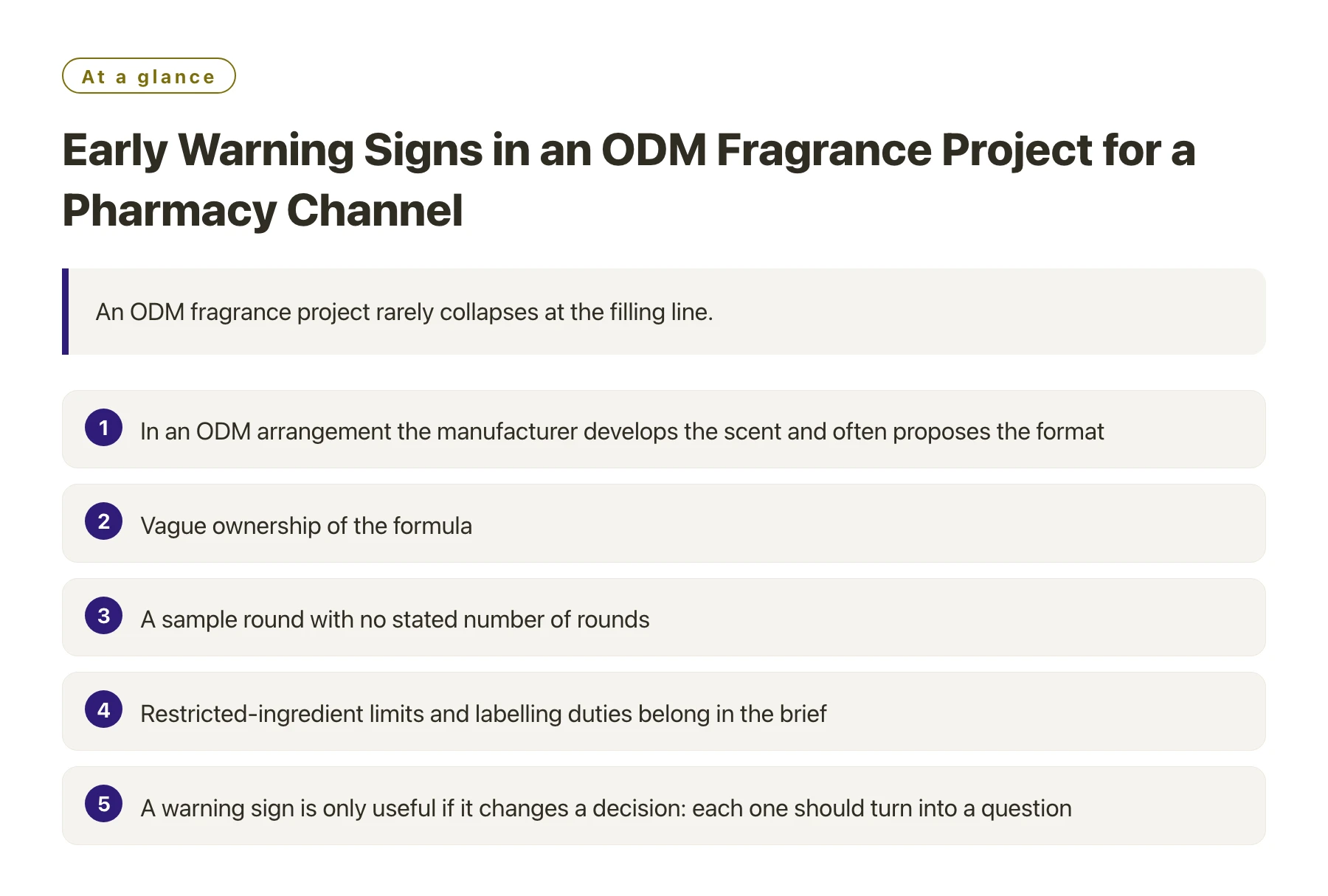
- In an ODM arrangement the manufacturer develops the scent and often proposes the format, so the brief has to pin down direction, dosage, claims and channel constraints before the first sample is compounded.
- Vague ownership of the formula, the artwork or the packaging specification is the most common early red flag, and it is cheapest to fix before development starts.
- A sample round with no stated number of rounds, no fixed review dates and no written approval criteria quietly adds weeks to a pharmacy launch.
- Restricted-ingredient limits and labelling duties belong in the brief, because they narrow what a perfumer can build and are expensive to discover after approval.
- A warning sign is only useful if it changes a decision: each one should turn into a question, a document request or a contract clause.
ODM projects attract warnings for a structural reason. In a straight OEM order the formula arrives finished and the job is to reproduce it faithfully; in ODM the manufacturer does more, developing the scent, proposing the dosage and frequently shaping the packaging route as well. That is efficient, and it also moves the buyer's control points. The things you would normally specify are now things you have to agree, in writing, while they are still cheap to change.
This walkthrough is written from the buyer's side of the table, for a pharmacy or drugstore own-label range. It covers how a sound project actually runs, the seven signals that reliably point to trouble, and the extra constraints that a pharmacy channel adds on top of the usual development work.
What a working ODM project looks like, in order
A conventional project opens with a written brief and ends with a sealed bottle, and every stage in between has an owner. The brief sets direction, dosage, format, claims, channel, volumes and a target cost. From there the manufacturer proposes two or three orientations, the buyer chooses a direction, sample rounds narrow it, and only then do stability checks, a compliance review against the applicable restricted-ingredient lists and bulk compounding follow. Nothing in that sequence is exotic; what matters is that each step has an input and an acceptance test.
When the brief is thin, the manufacturer fills the gaps with guesses. The first sample round is where that shows up, usually as scents that are pleasant but wrong, and the project pays for the guesses in extra rounds. A project run as ODM scent development in China is not a black box: the factory may hold the formula and the bench, but the buyer still owns the brief, the claims and the approval. Any partner who would rather not see those in writing is telling you something about how the next twelve months will go.
It also helps to know which half of the work you are buying. Development, fragrance compounding, filling, packaging sourcing and regulatory paperwork can sit with one supplier or be split across three. Split sourcing is not automatically worse, but it does mean that the interface between them, rather than the skill inside each, becomes the main risk to your timeline.
Seven warning signs, and the question each one should trigger
| Warning sign | What it usually points to | The question to ask next |
|---|---|---|
| No written brief, only a verbal direction | The factory is guessing at dosage, format and claims, so each sample round restarts the same conversation | Can you send me the brief you are working from, in writing? |
| Sample rounds with no stated limit or review dates | Nobody expects the project to converge; weeks are absorbed by re-briefing rather than by development | How many rounds are included in the price, and on what dates do we review? |
| Formula ownership left unmentioned | Ownership of the developed scent, and the right to reuse it later, will be negotiated at the worst possible moment | Who owns the formula after we pay for development, and can we take it elsewhere? |
| Ingredient restrictions raised only at the end | Compliance was treated as paperwork rather than as a design constraint | Which restricted-ingredient list will you formulate against, and who documents it? |
| Packaging proposed before the scent is settled | The project is being shaped by what is already in the warehouse rather than by what the channel needs | Which parts of this specification are ours, and which parts are yours? |
| One contact, no named owner for approvals | Decisions will be made verbally and revisited, with no audit trail behind a claim or a label | Who signs the approved standard, and what exactly does that signed document contain? |
| Lead times quoted with no production calendar attached | The date was an aspiration rather than a schedule with your own inputs marked on it | What do you need from me, and by when, for that date to hold? |
Each row is a question, not a verdict. A factory with thin process can still deliver a simple pharmacy range, and a factory with thick process can still be wrong for your channel. The point is to make the answer explicit while the project is still cheap to redirect.
Where a pharmacy channel adds its own pressure
A drugstore own-label scent is usually sold on the strength of the retailer's existing trust rather than on the reputation of the fragrance. That single fact changes the brief. Shelf position next to regulated products invites closer reading of the label, staff are often asked to explain what a product contains, and a claim that would pass unremarked in a fashion store gets questioned here. Most of this is ordinary due diligence on a perfume manufacturer: a document request, a walk through the plant, and a written question list that you insist is answered in writing.
Fragrance materials are not unregulated territory. The IFRA Standards set usage limits and restrictions for individual materials, and a compliant formula is built against those limits rather than checked against them afterwards [1]. In the European Union, the CosIng ingredient database and the cosmetics framework govern what may be used and what has to appear on the label, which is why the compliance question belongs in the brief and not in a late review [2].
The practical test is evidence, not confidence. Independent laboratories test cosmetics and personal care products for stability, compatibility and safety-related parameters, and a partner who already works with one has a shorter path to the documentation your channel will ask for [3]. Ask to see the forms rather than a summary of them.
Test the paperwork as hard as you test the scent
Buyers spend their sample budget on smelling and their patience on paperwork, which is the wrong way round. A scent that is right and a specification that is incomplete will still stop at the channel's compliance desk, and by then the sample round has been paid for twice.
The difference between a supplier that blends to a formula and Xuelei shows up in these answers. Ask what the formula was built against, who signed the approved standard, and how a later change to a raw material supplier would be communicated to you. The replies tell you more about quality than any tour of the blending room.
Write the brief before you ask for a price. In ODM work the brief is not an administrative document, it is the specification: dosage, format, claims, restrictions, approval criteria and the documents you expect at the end. A supplier who receives a good brief will still ask questions, and those questions are exactly what you want to be paying for.
Sources
- IFRA Standards Library (International Fragrance Association) —— The IFRA Standards Library lists the restrictions the fragrance industry applies to individual fragrance ingredients, based on safety assessments; it is the reference point for compliant fragrance formulation.
- EU CosIng — Cosmetic Ingredient Database (European Commission) —— The European Commission's CosIng database of cosmetic ingredients, listing ingredient functions, restrictions and labelling requirements under EU cosmetics law.
- SGS: Cosmetics, Personal Care & Household Testing —— Testing, inspection and certification services for cosmetics and personal care, including microbiological, stability and safety testing aligned with cosmetics GMP.
Frequently asked questions
What is the earliest red flag in an ODM fragrance project?
No written brief. Without it the manufacturer is guessing at dosage, format and claims, and every sample round restarts the same conversation instead of narrowing the field.
Does an ODM manufacturer own the scent it develops for us?
That depends entirely on the contract, which is why it should be settled before development starts. A development fee normally buys defined rights, and the scope of those rights has to be written down rather than assumed.
How many sample rounds should a pharmacy range expect?
There is no standard number, but the price should state how many rounds are included and the project should have fixed review dates. Open-ended rounds are a scheduling risk, not a sign of care.
Should restricted-ingredient checks happen before or after sampling?
Before. Restriction lists narrow what a perfumer can use, so treating them as a late compliance step usually forces a reformulation after the scent has already been approved and costed.
How do we judge the answers if we are not perfumers ourselves?
Ask for documents rather than opinions: the brief, the specification, the stability protocol, the restriction list the formula was built against, and the names on the approval sheet.
Commission your next hero set.
Tell us the launch, the silhouettes, and the deadline. We’ll return a shot list, a quote, and a confirmed studio date within one business day.